
Well, a bad situation occurred in a game between the Los Angeles Angels and New York Mets on Wed. July 23, 2025. A completely incompetent home plate umpire made not one, not two, but three bad calls in a critical at-bat in the game. One in which the visiting Halos could have benefited from if three bad strikes called on the way outer boundaries past the strike zone were not called. And this fiasco also points out the need for a fully-operational automated ball-strike system next year for Major League Baseball, which has implemented a load of rules changes in the past several years that make a game in 2017 look way different than a game that is played in modern-times.
The next step in that chapter of making the game better for the players and fans watching is the creation of the ABS system and its eventual promotion to the big leagues. But we still have to keep waiting on it, even though it has been used in games at some Spring Training ballparks earlier this year and has even been used in the MLB All-Star Game just one week ago. The ABS system is used in a challenge format where each team receives two challenges per game to review whether a strike or ball called by the umpire was accurately called within the parameters of the displayed strike zone for each hitter. If the team gets a call reversed by ABS, then that team retains that challenge. But if they get two ABS challenges wrong, then they will not have the ability to challenge a called ball or strike by the home plate umpire for the rest of a game. That flaw should be adequately addressed by allowing the ABS to have full discretion on the strike zone and for home plate umpires to go the way of the dodo bird. But there’s a lot of umpires who don’t want their crews to be reduced, even though they can all be eventually replaced by AI robotic umpires in the future. The Umpires’ union will go through hell and back to try to prevent that from happening, but it’s an inevitability. There’s already a lot of jobs that have been or are going to be taken over by artificial intelligence systems, why should sports officiating jobs be exempt?
I’m writing this as a rant against the officiating job that might be one of the most revered in all of sports. But when the guy behind the plate makes a bad call, then there are always going to be people that will criticize that person for their mistake and not be so constructive with their feedback. That leads to unnecessary human tension that gets coaches and players ejected from a game and in some instances suspended. There are very few who would say in this modern age to give the umps a break, because there’s always at least one(or two, or three plus) call(s) that an umpire makes during the process of a game that is factually and undoubtedly wrong. The ability to reverse the mistakes that umps have made has expanded substantially over the years, with replay centers helping them review plays that managers challenge throughout a game. But there’s still one authority that umps hold supreme and that is the power to call balls and strikes at home plate in at-bats between a pitcher and a batter. The strike zone varies for each hitter based on their height from the low points of the elbows down to where the knees are. Officiating the strike zone is an unimaginably hard task for umpires in the moment and they have other things to worry about such as getting hit by a ball fouled back towards them(which is why the home plate umps wear protective face masks along with catchers) and making other calls such as outs at the plate, calling a batted ball fair or foul(something that they are relatively perfect at), and dealing with checking pitchers for any illegal substances on their body. But for one man to have that much power vested in him, even for a trivial sporting event such as a baseball game, is kind of authoritarian and points to the home plate umpire being like something of a rogue judge wielding too much power over interpreting the laws. If the interpretation is seen as wrong by a large amount of people, then there is an uproar and rage. Unlike rogue district judges, the calls made by umpires cannot be reversed. At least not yet. But soon, they could be in specific instances should the player on the wrong side of a strike zone call choose to challenge the call.
I write this in a hopeful tone but also with blistering fury as another “rare” incident of a team being robbed of potentially scoring some huge important runs occurred at the hands of a home plate umpire who made a few bad calls in regards to the strike zone. It seems that these instances are forgotten for the most part among fans viewing baseball games who, like the players and coaches, have to move on to the next day in a gruesomely long 162-game regular season. But there are times when the calls made by an umpire are so bad you don’t want to forget the name of the mask-wearing fool who made those bad calls. This incident that I am about to discuss is one of those instances and I will definitely not forget it now that it is in written form. The next time an umpire that makes extremely bad calls against your team officiates a game that the team is involved in, you will not forget his name, nor forgive the wrong calls that he made that robbed the team of a potential victory. First, let’s set the stage for this fiasco and why it turned out to be so critical and infuriating.
The Angels were in the midst of playing a series finale against the New York Mets at Citi Field. They had lost the first two games by close margins after squandering leads that they had built up in the early parts of those games. Trying to avoid a sweep against a Mets team also desperate for a win, the Halos needed to respond with a victory that could have given them positive “momentum” heading into a superlong 13-game homestand. Being in a packed and clunky AL Wild Card chase, this was a must-win game for the Angels and unfortunately they would fall behind early on a day where the bullpen was tasked to eat up some innings due to the current four-man starting rotation that the team is dealing with. A four-run third inning by the Mets against lefty-reliever Jake Eder didn’t help matters and the Mets got an extra run in the bottom of the fourth. The Halos’ bats were being neutralized by lefty starter Sean Manaea, who pitched five solid innings against them and the only run that was scored off of him was a solo home run hit by Mike Trout for his 999th career RBI and 396th career home run. However, in the top of the 7th inning, the Angels attempted to fight back as a couple of leadoff hits by Kevin Newman and Travis d’Arnaud boded well for them and led to a couple of runs. The Halos were unable to get more and were down 6-3 against New York’s National League team.
After a clean bottom of the 7th pitched by Eder, the top of the 8th inning came and lefty reliever Brooks Raley came back into the game after getting out of the top of the 7th inning jam that the Angels were unable to put a really crooked number on. Raley walked Taylor Ward to start out the inning, then struck out Jo Adell on a pitch that looked like it barely touched the bottom part of the zone. Following a mighty swing that almost had the ball go out for a two-run shot by Logan O’Hoppe, Mets manager Carlos Mendoza decided to take Raley out of the game and bring in his closer Edwin Diaz for a four-out save situation. d’Arnaud was up to bat and he would get hit by a pitch thrown inside by Diaz and now the game-tying run was coming up to the plate. Luis Rengifo doesn’t really have serious home run power, but he would seek to at least get on base and potentially bring both runners home on a clutch hit. The first pitch thrown by Diaz was a bit outside, but the home plate umpire Erich Bacchus called it a strike. A pretty odd call there, as the catcher’s framing of the pitch was rewarded. The next three pitches thrown by Diaz were balls that were way outside the strike zone and if that first pitch had been called a ball, Rengifo would be on first base with a walk. The next two pitches is where hell broke loose at home plate.
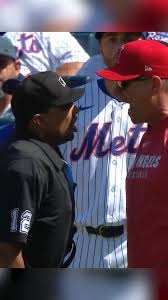
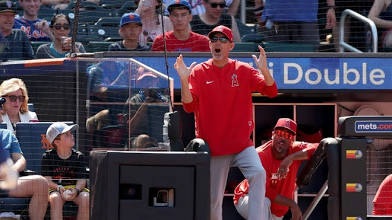
The next pitch thrown by Diaz was on the outside part of the plate again, but just like the first pitch it was called a strike. The count was full after Bacchus’ second bad call of the at-bat. The next pitch would determine whether this inning continued or ended. The 3-2 slider thrown by Diaz again landed well away from the outside corner of the strike zone, but Erich Bacchus called it strike three! Rengifo could not believe it and Ray Montgomery was already ticked at the two bad calls earlier in the at-bat. Montgomery came out of the dugout to argue, but the umpire used his rulebook-induced authority to eject Montgomery from the game. One of the dumbest authoritarian rules in sports history was used yet again, protecting umpires from further chirping from the offended party. An absolute sick joke of a situation. If Rengifo would have had one of those three bad strike calls be called ball four, it would have made him the game-tying run at first base and Chris Taylor was set to come up after belting an RBI double in the 7th inning. But instead Mr. Bacchus had it his way and decided to reward Edwin Diaz and not tick off the home fans of the Mets with an obvious ball four call. These home-field calls need to stop. Even though I like it when the Angels get some bad calls in their favor, the umpire is supposed to be a neutral arbiter of the game and make calls in a clear and fair manner. What occurred on Wednesday afternoon in Flushing-Queens was nowhere close to clear or fair. It was an obstruction of justice, something that occurs way too much in a human-populated world. And particularly in sports, especially the supposed national pastime of the U.S.A.
Big bad Bacchus(who is a babyfaced Millennial by the way) wasn’t done yet, as he tossed out the “offensive coordinator” for the Angels Tim Laker, who decided to voice his dissent for those bad calls after an inside pitch on the right-side of the plate was called a ball in the bottom of the 8th inning. Laker gave his two cents and was shielded by crew chief umpire Laz Diaz from going after Bacchus. So, that stunk. The top of the ninth inning featured little resistance from the Halos, who saw Chris Taylor get plunked in the helmet by Edwin Diaz. That base runner didn’t matter unless another guy got on and that did not happen. The smooth-throwing Diaz got the top three hitters in the Angels lineup out in successive order and the Mets had completed the sweep. The Halos had fallen to four games under .500 and further behind in the standings. Three losses, one of them by two runs, the second by one run, and the third by three runs, at Citi Field that could have been wins if they did better at padding their leads and scoring more with runners on base. But this incident was another reminder of why umpires struggle to call the strike zone efficiently enough and an example of a young umpire who has seen the automated ball-strike system implemented in the minor leagues(where he was before being promoted to the big leagues a couple of years ago) failing in the biggest moment of the game. An absolute atrocity that should not be forgotten and will not be forgiven by me and a load of other enraged fans.
The ABS will eventually be another tool used to prevent nonsensical calls at home plate by umpires, but another thing that could be challenged in the near future is check swings. A challenge system regarding the angle at which a bat has to cross the plate in order to be considered a strike is being experimented with in a minor league in Florida currently. So, the call that the home plate umpire defers to the corner umpires at first and third base could be challenged if a team sees that the bat either did or did not cross that 45-degree threshold for a check swing to be ruled a strike. The ABS will do for now, if only it could be implemented at every ballpark in the middle of this season. But due to the umpire union, it won’t see the light of day until next season, at the earliest. Let’s hope that union representing the black and baby-blue shirted gentlemen(and women, if that is even a future possibility) does not prevent this from being a thing. Rob Manfred has already seen the success of the ABS in games in the minor leagues, Spring Training and the All-Star Game. What more does the commissioner need to see? It will be just like tennis with individual players having a challenge system to appeal a call made by the umpires in that sport to overturn a ball-line call that they don’t agree with. That system has been in place for so many years and born out of a frustrating phrase made by American tennis star John McEnroe to a chair umpire in the 1980s(well before instant replay was even a remote possibility in sports), which was “You cannot be serious!”
That’s the same reaction for me in my head in lamenting why baseball always has to be the last to the party of common sense changes in how their game is officiated. The invitation is still open, but how much will it be accepted? Hopefully a lot if the fans like what they see with the ABS at ballparks. Another odd fixture to get used to, but we already have the pitch timer dictating the length of a game and other necessary rules as well to prevent lollygagging by players on the field. I’m sure we will be just fine with the Automated Ball-Strike System, even when the calls go against our favorite team. Better to have a digital simulated screen be the arbiter of truth than the weak eyes of a human home plate umpire. That’s the route we’ve chosen to take, for better or worse.
 Kent Bewley's News Story Collection
Leave a comment